FSR 0232
(MWSC 3306)
0.09
UTI
0.0
CN
0.1
Cdens
0.12
CC3
0.12
Clit
1.0
Cdup
Nm (P>50%)
21
Core radius and density
3.3 [pc], 0.5 [pc-2]
- CN 0.0 Sparse
- Cdens 0.1 Very loose
- CC3 0.12 Very low quality
- Clit 0.12 Rarely studied
- Cdup 1.0 Unique
 MOCA
MOCA
Overview
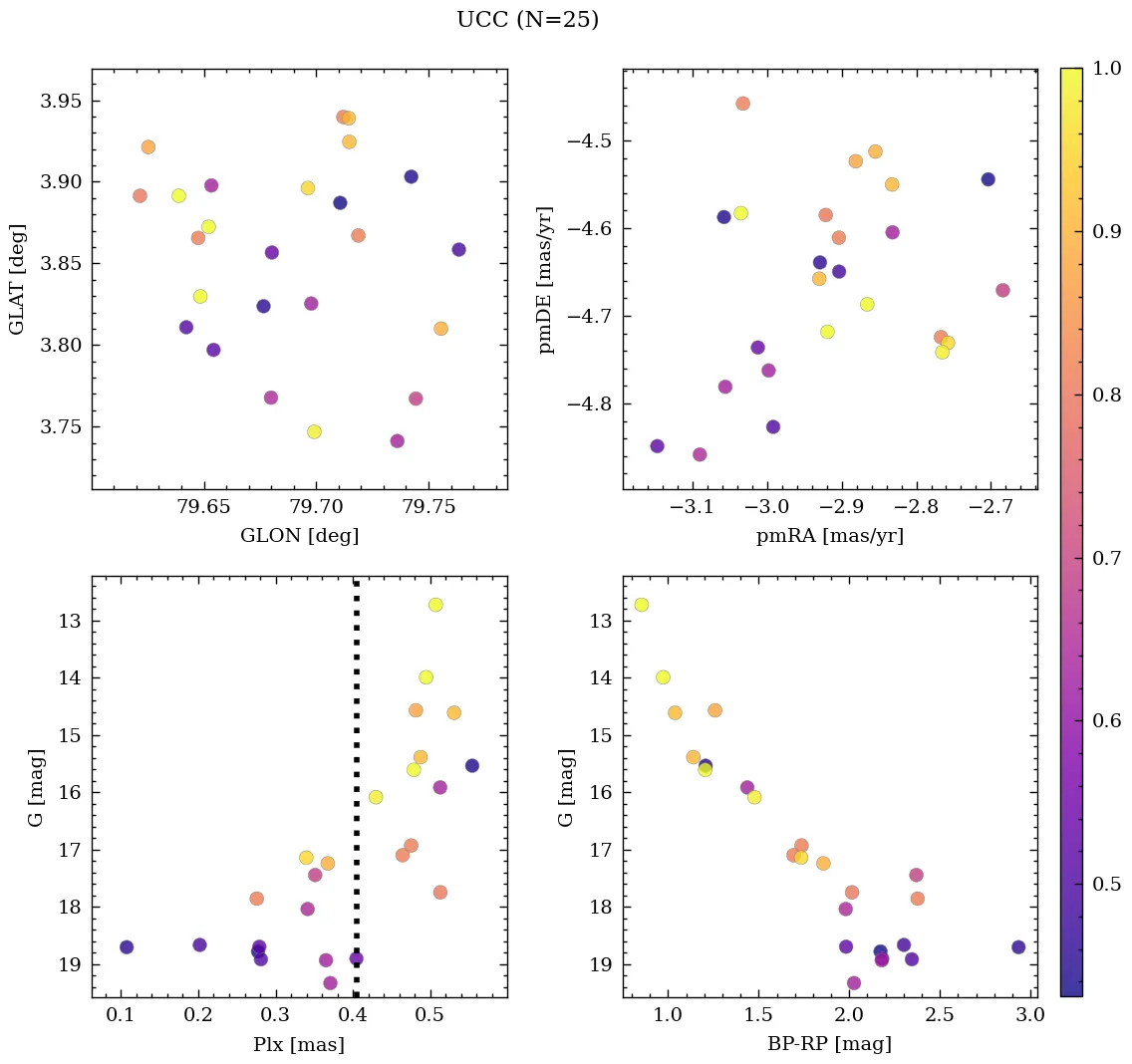
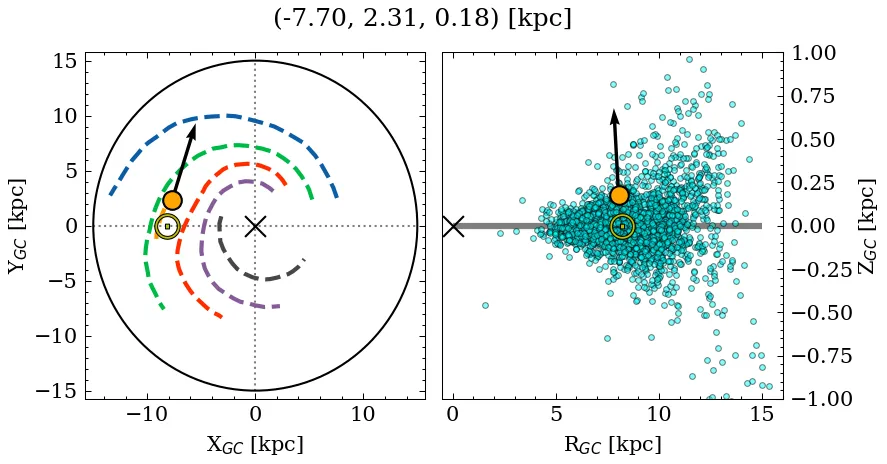
FSR 0232 is a sparse, very loose object of very low C3 quality. Its parallax locates it at a moderate* distance, above the mid-plane, affected by moderate extinction. It is catalogued as an intermediate-age cluster (see Parameters). It is rarely studied in the literature, with no articles listed in the last 7 years.
(*): The parallax distance estimate (~2.47 kpc) differs significantly from the median photometric distance (~1.55 kpc).
Note: This object shares a small percentage of members with a later reported entry. See table with shared members information.
⚠️ Warning: the low UTI value and no obvious signs of duplication (Cdup=1.0) indicate that this is quite probably an asterism, moving group, or artifact, and not a real open cluster.
Data
| Reference | Year | RA [deg] | DEC [deg] | Plx [mas] | pmRA [mas/yr] | pmDE [mas/yr] | Rv [km/s] |
|---|---|---|---|---|---|---|---|
| UCC | 99999– | 304.519 | 42.64 | 0.405 | -2.919 | -4.658 | – |
| Bica et al. | 2019 | 304.557 | 42.636 | – | – | – | – |
| Dib et al. | 2018 | 304.579 | 42.625 | – | – | – | – |
| Dias et al. | 2016 | 304.558 | 42.631 | – | 0.81 | -3.47 | – |
| Froebrich et al. | 2007 | 304.558 | 42.631 | – | – | – | – |
💡 Note: The UCC values are estimated from its identified members.
| Reference | Year | Dist [kpc] | Av [mag] | DAv [mag] | Age [Myr] | [Fe/H] [dex] | Mass [Msun] | Bfrac | BSS |
|---|---|---|---|---|---|---|---|---|---|
| UCC | 99999– | 1.55 | 2.5 | – | 141 | – | – | – | – |
| Dib et al. | 2018 | 1.55 | – | – | 141 | – | – | – | – |
| Dias et al. | 2016 | 1.55 | 2.50 | – | 141 | – | – | – | – |